

3 September 2026 marked the 81st anniversary of victory. At the deep space exploration conference in Hefei, the International Lunar Village Centre and four joint laboratories were formally inaugurated. The same day, Hong Kong held an official commemoration and Beijing a memorial symposium — different places looking back on the same history, and measuring the same future.

Eighty-one years ago, this country could not manufacture a single standard bolt to specification. Workers in arsenals heated metal in furnaces, forged by hand and fitted parts with files. Take a component off one rifle and it usually had to be reworked before it would fit another. Damaged aircraft were hard to repair, because both the precision parts and the means of inspecting them were held elsewhere; once war cut the supply line, no amount of skill could compensate. Every aircraft lost to a failed component, every life lost to a weapon that would not shoot straight, came back to the same thing. There was no yardstick of our own.

Eighty years on, the same country is building lunar research stations, Mars probes and aero engines. A turbine blade works at tens of thousands of revolutions per minute at over a thousand degrees, where a deviation of a few microns can cause a failure. A sealing face on a spacecraft fuel valve has to be held inside 0.3 microns. That yardstick is now in our own hands.
Getting here was not easy. From depending on imports to building capability, from restriction to substitution, from being at others' mercy to holding the critical steps ourselves — countless companies fought for accuracy one micron at a time. AEH is one of them, working to build high-accuracy coordinate measuring machines and take micron-level accuracy back into its own hands. Air bearing guideways that let a machine run without a compressed air supply. Wide-range thermal compensation algorithms that let it work in an ordinary workshop. Twin-arm coordinated measurement for large aerospace structures. Every one of those steps answers a specific need for independent accuracy. In 2003 the company won its first order from an aero engine manufacturer, breaking an imported monopoly in a core defence application. Two decades later, from Shenyang to Chengdu, from turbine blades to spacecraft sections, its equipment is a trusted part of quality systems at the major aerospace manufacturers.
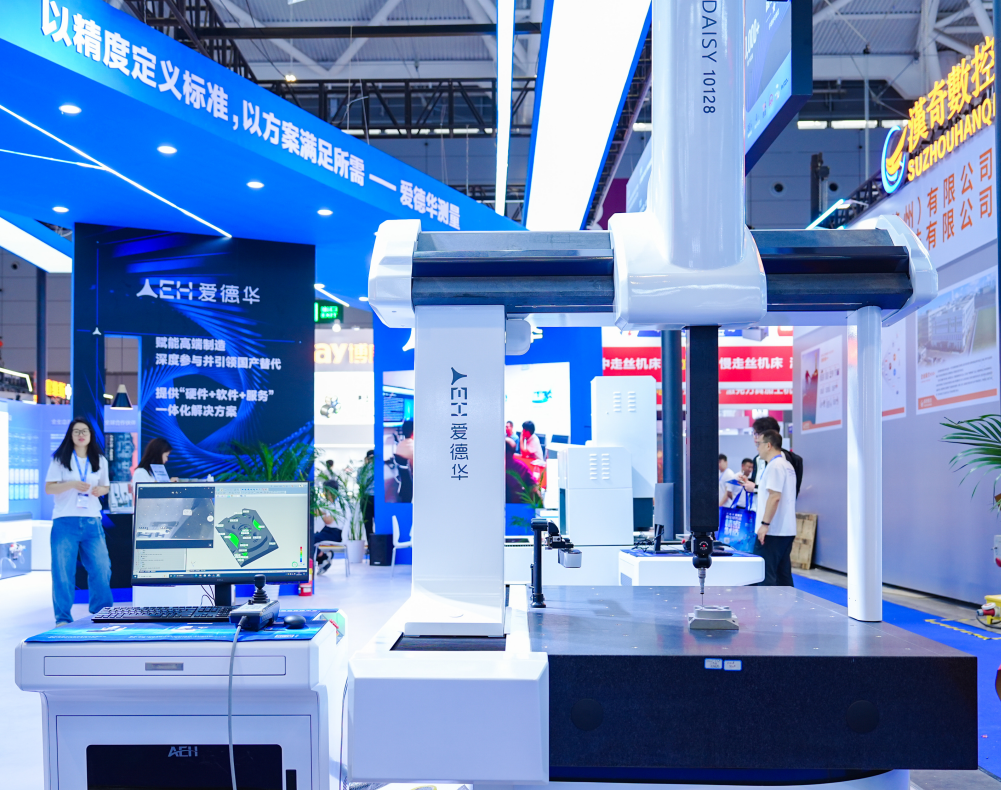
From whether a bolt meets specification to whether a spacecraft section will dock precisely, from assembly gaps in EV battery modules to microscopic dimensional control in semiconductor packaging — every detail that bears on safety and performance has to be seen and measured accurately. For a long time that instrument was in someone else's hands. From the 1990s into the 2000s, virtually every coordinate measuring machine used in advanced manufacturing here was imported, costing several million yuan, with software updates, spare parts and service all controlled elsewhere, and defence-related product data inspected on foreign equipment. That was a technical dependence, and a security concern. It was companies willing to work in a field no one wanted to invest in, on problems no one believed could be solved, that produced today's position.
Building genuine independence was never a slogan. It is an almost unreasonable insistence, and at AEH it takes a specific form: engineers no longer having to rely on someone else's standards, someone else's data or someone else's service, and manufacturing data that matters staying on equipment we control. There is no shortcut. It is the accuracy check run every morning in a temperature-controlled workshop before anything is switched on. It is an engineer working through algorithm parameters against a data curve, again. It is a hundred repeatability tests with reference spheres before a machine is allowed to ship. Countless ordinary days that nobody outside ever sees are what turned cannot make it into make it accurately.
Eighty-one years ago, an earlier generation held the line with what they had. Today it is held with accuracy. When measurement equipment we control safeguards every manufacturing step, and micron-level tolerances govern the quality of every spacecraft component, progress in precision becomes its own form of security. This generation has a firm grip on the instrument.