

August 2026 brought a milestone in computing infrastructure: the first fully domestic 100,000-card AI supercluster entered service, taking deployment to a new scale. Shortly before, computing networks were designated national infrastructure for the first time, placed alongside water and power. An integrated national computing network is being built out quickly, opening an investment cycle measured in trillions.
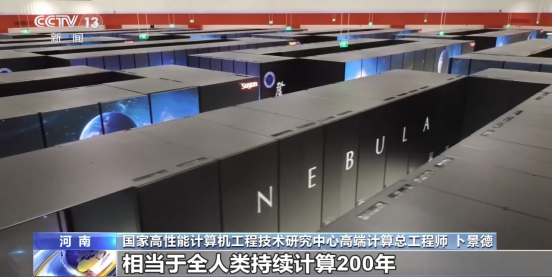
Image: CNR (screenshot from CCTV News)
Behind that expansion sits one decisive problem: heat. Precision measurement companies have already begun positioning around it, and AEH — nearly thirty years in this field — is turning its attention to liquid cooling, a market worth hundreds of billions.
Under NVIDIA's Blackwell architecture, a single GB200 NVL72 rack has a thermal design power of 120 to 132kW. Conventional air cooling simply cannot cope. Liquid cooling has moved from optional to essential. CICC forecasts 2026 as the year volume arrives, with the global intelligent computing centre liquid cooling market reaching ¥114.7 billion, up 273% year on year, and liquid-cooled server penetration rising from 12% in 2025 to 28%.
As liquid cooling scales, pressure moves down the supply chain. The machining accuracy of manifolds, cold plates and quick connectors directly determines cooling efficiency and system reliability. A manifold's multiple port positions must hold position and perpendicularity tolerances; a cold plate's channel dimensions, fin parameters and flatness govern how well it dissipates heat. Let those drift and cooling efficiency falls sharply — or servers overheat and go down.
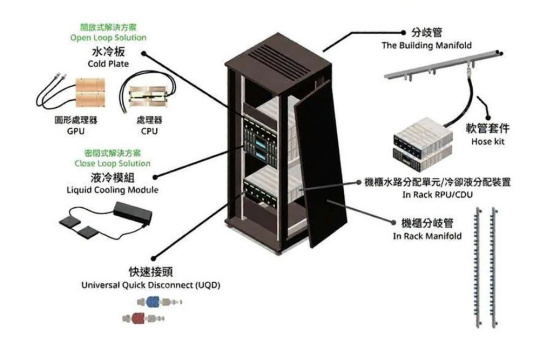
Image: web
So who guarantees the quality of liquid cooling components?
From general-purpose to purpose-built: measurement designed for liquid cooling
Conventional inspection struggles here. Contact coordinate measurement is slow, scanning point by point. Manual inspection is subjective and inconsistent. General-purpose optical systems, faced with a manifold that is long, slender and symmetrical on both sides, usually need repeated setups and adjustment.
AEH's answer is a dual-line laser scanning measuring machine. Built for inline measurement of liquid cooling pipework, it needs no compressed air, actively compensates across a wide temperature range, and measures with two arms working together. A twin cantilever structure carries both a touch-trigger probe and a 3D laser scanning probe for genuine multi-sensor measurement.
On accuracy, careful calibration and error compensation between the two probes hold combined measuring accuracy at ≤0.05mm. On speed, two Keyence LJ-X8080 blue-light dual-line laser heads scan in parallel, more than three times faster than contact measurement, with throughput on complex surfaces four to six times higher. On adaptability, non-contact laser scanning avoids scratching or distorting the part and copes well with reflective and oily surfaces across a range of materials. The dual-mode design lets surfaces be scanned at speed by laser while critical datum holes and deep features are located precisely by the trigger probe — one machine covering both fast scanning and high-accuracy datum measurement.
In Suzhou, a centre of the liquid cooling industry, many manufacturers of cold plates, manifolds, connectors and assemblies are looking for faster and more accurate inline inspection. The market is going through a difficult transition from bespoke work to standardised production, and inline, high-throughput measurement of these components has become decisive for who competes successfully.
A strategic position: precision measurement meets the computing era
Strategically, AEH's move into liquid cooling is not incidental. Making computing networks national infrastructure means the hardware manufacturing and quality inspection behind them will be upgraded systematically. Precision measurement is the gatekeeper in that process: without accurate inspection there is no reliable liquid cooling system, and without a reliable cooling system there is no stable computing output.
Launching a measurement solution for liquid cooling marks AEH's expansion from general-purpose coordinate measurement into a strategically important industry. What it solves is not only inspection throughput but a decisive step in the liquid cooling supply chain's move from volume to quality.
As national computing networks expand, and clusters of ten and a hundred thousand cards keep setting records, every component in a liquid cooling system has to withstand inspection at micron scale. AEH's dual-line laser scanning measuring machine is the last line of quality defence behind that build-out.