

Everything that happens in industrial manufacturing comes down to measurement.
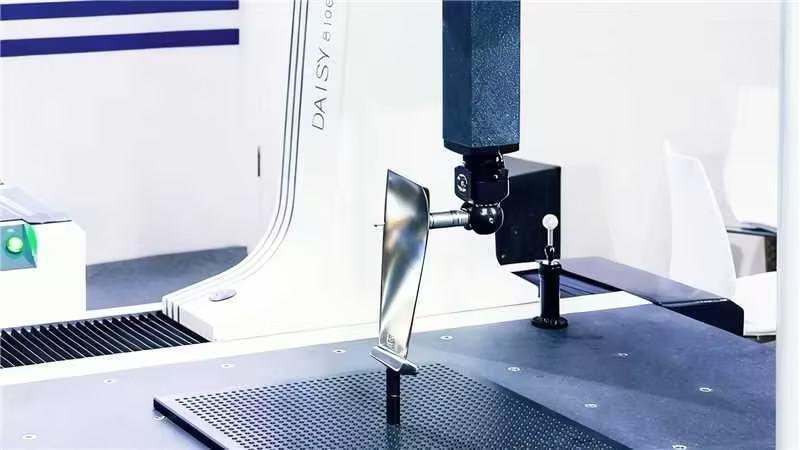
An aero engine blade has to run stably at tens of thousands of revolutions per minute. If the profile at a critical point is out by even 3 to 5 microns — roughly a twentieth of the diameter of a human hair — engine efficiency can fall sharply, and in the worst case the engine can fail.
That demand for absolute accuracy is what built Xi'an's precision measurement industry. For two decades the leading technology in this field sat with a handful of international companies. When advanced manufacturing needed that capability to define its own accuracy, Xi'an took it up and turned it into an industry of its own.
First: from borrowing the instrument to holding it
The breakthrough came in aero engines. From the 1990s into the 2000s, a coordinate measuring machine cost several million yuan and the core technology sat firmly abroad. For an aviation industry working hard to catch up, that meant not only cost but exposure on technology and data.
Xi'an chose to take the problem head-on. In 2003, Xi'an AEH Industrial Metrology won a competitive tender against the international leaders on measurement throughput and accuracy, taking the order from Xi'an Aero-Engine. "That was not only a first in aviation," chairman Song Jianzhong recalls. "It proved to the whole industry that in the most demanding application, our instrument was every bit as dependable."
What that instrument measured was not only the contour of a blade. It was the step from laboratory to a genuinely unforgiving industrial floor. Today, from Shenyang to Chengdu, it is standard equipment in quality control at the major aero engine manufacturers.
That breakthrough grew out of Xi'an's particular mix of universities and industry. Xi'an Jiaotong University and Northwestern Polytechnical University have deep roots in instrument science, supplying both core algorithms and people. And as a major centre of defence technology, the city's own industry provided the most demanding test bed a measurement technology could ask for.
While AEH broke the ice, institutes including the AVIC Precision Institute and the Xi'an Institute of Precision Instruments, along with other young companies, were working quietly on sensors, probes and other core components — laying the first foundations together.
From theory to application, laboratory to production line, the chain of innovation runs efficiently here.
Second: from one instrument to a complete standard
Taking up an existing instrument is only the beginning. The real work is building a full set of measurement capability matched to your own industrial system — core algorithms, key components and complete machines, across aerospace and every other sector, each configurable to the job.
So the second phase reached out from aerospace into wider industry. In electric vehicles, it now measures assembly gaps in battery modules and form and position tolerances on motor housings, protecting both safety and efficiency. In semiconductors, the technology has moved into precision inspection of chip packaging, anchoring quality at microscopic scale.
It is also no longer a single piece of hardware. In the Xi'an High-Tech Zone, with AEH at the centre, a group of highly specialised companies are building an innovation ecosystem and working closely together.
Some concentrate on industrial vision algorithms, giving inspection systems genuinely sharp eyes. Others work on high-accuracy laser interferometers — the standard against which the standard is set. Others again are merging large volumes of measurement data with MES systems, closing the last mile of quality control. Building on advanced measurement, together they are putting AI into inspection and moving quality control from checking after the fact to adjusting during the process.
The city's own plans say the same. Xi'an's implementation plan for the National Metrology Development Plan (2021-2035) sets the goal of building a modern, advanced measurement system. By 2035 the city intends not only to hold internationally advanced measurement technology but to have built a standards and capability system woven into how it manufactures, and able to develop itself.
Third: from measuring separately to measuring inside the process
As intelligent manufacturing advances, precision measurement is moving from offline inspection to online monitoring, and from checking afterwards to controlling during. Xi'an's measurement companies are among the first movers, combining measurement with AI and industrial networking to give manufacturing systems both eyes that sense quality and a brain that acts on it.
"Measurement will stop being a quality inspector standing beside the line and become a nerve ending inside the process," says Deng Xiaofeng, AEH's chief technical adviser. Getting there depends on the whole ecosystem developing together. In Xi'an, measurement companies, industrial software firms, university laboratories and end users are forming joint teams around intelligent inline inspection and closing the loop on quality data, working from prototype through to validation on real lines.
That integration is reshaping how manufacturers manage quality. "Moving from supplying a single machine to building a quality solution that senses, connects, analyses and feeds back — that is the step we have to make," Deng says. "Intelligent measurement is not only a technical upgrade but a change in thinking. It turns quality control from reacting into optimising, and that is where the real value is."
From borrowing the instrument to holding it; from a single instrument to a standard that defines accuracy across industries; from measuring separately to measuring inside the process — three stages that together trace a path from catching up to running alongside, and in places to leading.
What this instrument means goes beyond the equipment itself. It is what decades of industrial persistence produced in answer to a national question about accuracy and security, and an example of what happens when research and industry combine under genuinely demanding requirements. Heavy machines rest on fractions of a millimetre.
As the capability forged in Xi'an works its way into intelligent manufacturing in China and beyond, it protects the reliability of every take-off and the safety of every journey — and quietly marks out where the boundaries of industrial accuracy might sit next.